


Colorado Wage and Hour Laws


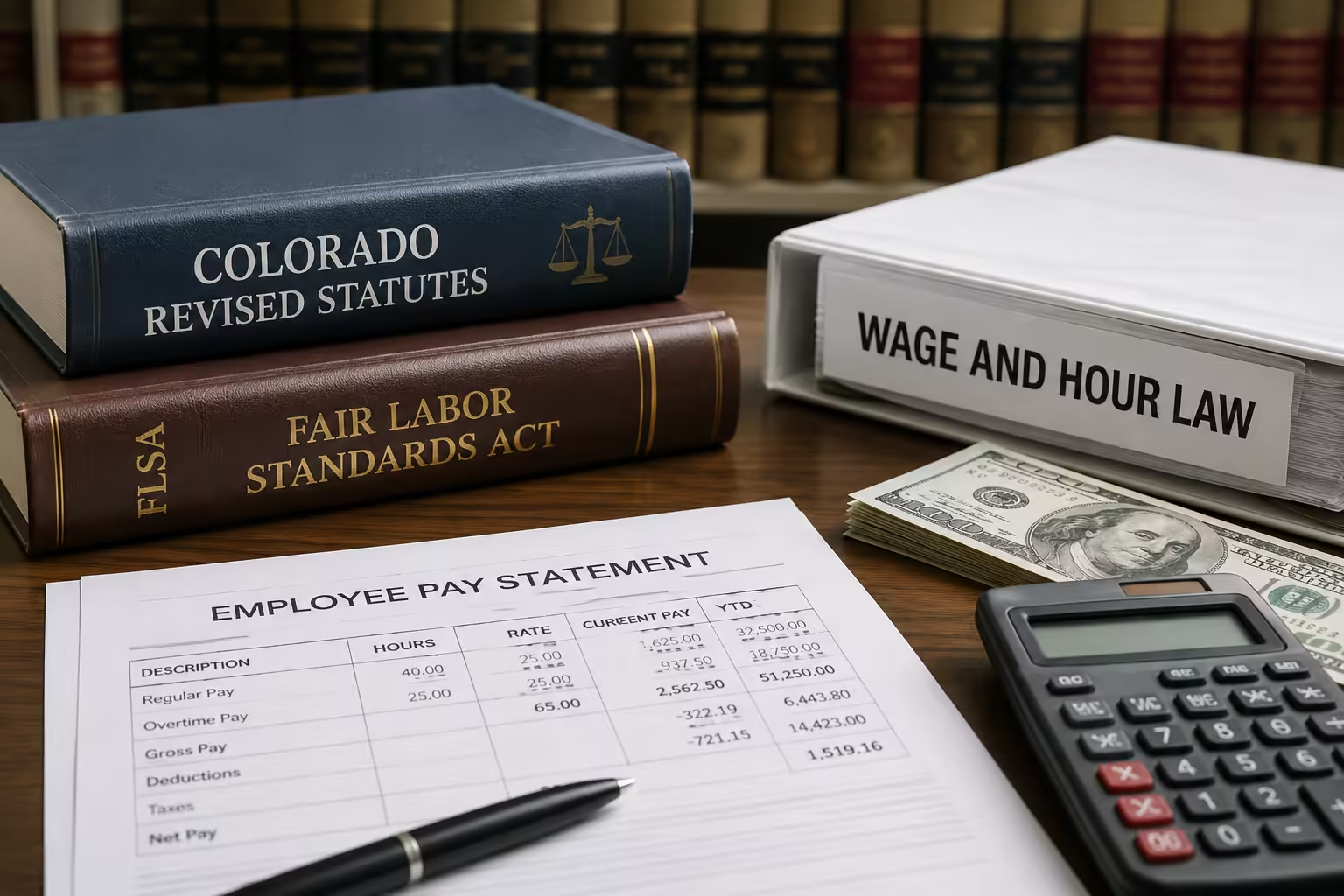
Colorado and federal law guarantee employees the right to fair pay, lawful overtime compensation, and equal wages for equal work. Colorado wage and hour laws, including the Colorado Wage Act (C.R.S. §§ 8-4-101 through 8-4-123), the Colorado Overtime and Minimum Pay Standards (COMPS) Order, the Colorado Equal Pay for Equal Work Act (C.R.S. § 8-5-101 et seq.), and the federal Fair Labor Standards Act (FLSA), set minimum standards for wages, overtime, final paychecks, and payroll deductions that all covered employers must follow.
At Elkus & Sisson, P.C., our Colorado employment law attorneys represent employees across the state, including Denver, Greenwood Village, Lakewood, Aurora, and the Denver-metro area, who have experienced unpaid wages, denied overtime, equal pay violations, or other wage and hour violations. We guide clients through filing administrative complaints with the Colorado Department of Labor and Employment (CDLE), pursuing written demands for back wages, and litigating claims in state or federal court when necessary.
Understanding Colorado Wage and Hour Laws
Colorado’s wage and hour protections are built from overlapping state and federal statutes that together establish the floor for employee compensation rights. Understanding how these laws work together is essential to knowing when a violation has occurred and what remedies are available.
- Colorado Wage Act (C.R.S. §§ 8-4-101 – 8-4-123) The primary state statute governing wage payment in Colorado. It requires employers to pay all earned, vested, and determinable wages in a timely manner and establishes penalties for employers who fail to do so. The Colorado legislature has stated that the Act “should be liberally construed” in favor of employees to ensure timely payment of wages.[1]
- Colorado Overtime and Minimum Pay Standards (COMPS) Order The COMPS Order, issued by the Colorado Division of Labor Standards and Statistics, establishes Colorado’s minimum wage and overtime requirements. It also establishes rules for meal and rest periods, travel time, and on-call pay, and in several key respects provides employees with greater protections than federal law.[2]
- Colorado Equal Pay for Equal Work Act (C.R.S. § 8-5-101 et seq.) Enacted in 2021 and strengthened by amendments in 2023, Colorado’s Equal Pay for Equal Work Act requires employers to compensate employees performing substantially similar work at equal rates, regardless of sex or other protected characteristics. It also requires employers to post salary ranges in job listings and notify current employees of promotional opportunities. [3]
- Fair Labor Standards Act (FLSA, 29 U.S.C. § 201 et seq.) The federal baseline for minimum wage and overtime protections. Colorado law frequently exceeds federal minimums, and employees are entitled to the greater protection when state and federal law differ.[4]
Wage and hour violations often intersect with other employment law issues, including workplace retaliation, particularly when an employer retaliates against an employee for making a wage complaint, and wrongful termination when an employee is fired for asserting wage rights.
Common Colorado Wage and Hour Violations
Colorado wage and hour violations occur across a wide range of industries and circumstances. The most common types our attorneys handle include:
Unpaid Wages and Wage Theft
Employers are required to pay all earned wages, including salary, hourly pay, commissions, bonuses, and earned vacation, in full and on time. When an employer withholds wages an employee has already earned, that constitutes wage theft under Colorado law. The Wage Theft Transparency Act requires the CDLE to publicly post all final adverse determinations against Colorado employers who have been found to have violated wage and hour law.[6]
Overtime Violations
Colorado law provides employees with overtime protections that exceed federal standards in an important way: employees are entitled to overtime pay not only after 40 hours in a workweek (as under the FLSA), but also after 12 hours in a single workday, and after 12 consecutive hours of work regardless of the workday’s start and end times. Overtime must be paid at no less than 1.5 times the employee’s regular rate of pay. Employers who deny overtime pay or misclassify employees as exempt to avoid paying overtime may be liable for back wages and additional penalties. [5]
Minimum Wage Violations
Colorado has strict rules governing when final wages must be paid after the end of employment:
- If an employee is discharged (fired or laid off): All earned, vested, and determinable wages are immediately due and payable. If the employer’s payroll office is not operating at that moment, the employer has up to 24 additional hours to make payment.
- If an employee voluntarily resigns: Unpaid wages must be made available no later than the next regularly scheduled payday.
Employers who delay final wages beyond these deadlines are subject to penalties under the Colorado Wage Act.
Illegal Paycheck Deductions
Employers are strictly prohibited from making unauthorized deductions from an employee’s wages. Permitted deductions are limited to:
- Taxes, social security, and court-ordered garnishments required by law
- Documented loans, advances, goods, or services provided pursuant to a written agreement
- Authorized deductions for benefits such as health insurance or retirement plans, where the employee’s authorization is revocable
- Theft-related deductions, only after a law enforcement report has been filed and subject to strict procedural requirements
Any deduction not falling into one of these categories, or any deduction that takes wages below the applicable minimum wage, is unlawful under the Colorado Wage Act.
Equal Pay Violations
Under the Colorado Equal Pay for Equal Work Act, employees performing work that is substantially similar in skill, effort, and responsibility, regardless of job title, must be compensated at equal rates. Employers cannot justify pay disparities based on sex alone or on compensation history. An employer who pays a female employee less than a male employee performing the same work, or vice versa, may be liable for back pay, liquidated damages, and attorney fees. Employers are also required to include salary ranges in job postings and notify employees of internal promotional opportunities.
Employee Misclassification
Classifying a worker as an independent contractor rather than an employee does not automatically make that person an independent contractor under Colorado law. The key question is whether the employer controls the manner and method of the work. Workers who are misclassified as independent contractors may be improperly denied minimum wage, overtime, and other protections provided by the Colorado Wage Act and COMPS Order. An employer’s use of an “independent contractor agreement” is not conclusive, courts and the CDLE look at the actual working relationship.
Meal and Rest Period Violations
The COMPS Order entitles most Colorado employees to:
- A 30-minute uninterrupted meal period for shifts of five consecutive hours or more (may be unpaid if the employee is fully relieved of duties)
- A 10-minute paid rest period for every four hours worked, or major fraction thereof
Employers who deny meal and rest periods, require employees to work through them without compensation, or fail to count rest breaks as paid time may be in violation of Colorado wage and hour laws.
How Courts Evaluate Colorado Workplace Retaliation Claims
Colorado wage and hour violations carry significant penalties. Employees who have not been paid wages they are owed have several enforcement options:
Written Demand and Automatic Penalties
An employee may send a written demand for unpaid wages to the employer. If the employer fails to pay all owed wages within 14 days of receiving a written demand or after a complaint or civil action is filed:
- The employer is liable for the unpaid wages plus an automatic penalty of the greater of two times the unpaid wages or $1,000
- If the employer’s failure to pay was willful, the penalty increases to the greater of three times the unpaid wages or $3,000
- An employer’s failure is considered per se willful if the employer has failed to pay wages of a similar type to any employee within the five years preceding the claim
Civil Theft (Treble Damages)
The Colorado Wage Act makes it theft under Colorado law for an employer to willfully refuse to pay wages, falsely deny the amount owed, or otherwise deprive an employee of earned compensation with intent to defraud. Under Colorado’s civil theft statute (C.R.S. § 18-4-401), employees who can prove civil theft may recover treble damages (three times the amount wrongfully withheld) plus attorney fees and court costs.[7]
CDLE Administrative Complaints
For claims involving unpaid wages of $7,500 or less, filing an administrative complaint with the Colorado Department of Labor and Employment (CDLE) Division of Labor Standards and Statistics is often the most efficient path to recovery. The CDLE investigates the complaint and, if it finds in the employee’s favor, orders the employer to pay. Employers who fail to pay the amount determined within 60 days face additional wages owed, Wage Act penalties, the employee’s attorney fees (for awards over $5,000), and fines payable to the State of Colorado.
Court Litigation
For larger claims or when the CDLE process is not sufficient, employees may file suit in state or federal court. Prevailing employees may recover unpaid wages, penalties, liquidated damages, and attorney fees and costs.
Statute of Limitations
- General claims: 2 years from the date the violation occurred
- Willful violations: 3 years from the date the violation occurred
Missing these deadlines can permanently bar your right to recover. Consulting a Colorado wage and hour attorney as soon as possible after a suspected violation is critical.
The Colorado Equal Pay for Equal Work Act
The Colorado Equal Pay for Equal Work Act (effective January 1, 2021, and further strengthened by amendments effective January 1, 2024) established some of the strongest equal pay protections in the country. Key provisions include:
- Pay equity requirement: Employers must pay employees performing substantially similar work at equal rates, regardless of sex or other protected characteristics under the Colorado Anti-Discrimination Act
- Salary history ban: Employers may not seek or rely on an applicant’s prior compensation history to set pay
- Pay transparency in job postings: Employers must include the hourly or salary compensation range and a general description of benefits in all job postings, including for remote positions that could be performed by a Colorado employee
- Internal promotional opportunity notice: Employers must notify existing employees of promotional opportunities before or at the same time as posting the position externally
- Remedies for violations: Employees may recover back pay, liquidated damages equal to the amount of back pay owed, attorney fees, and costs. There is no cap on back pay recovery under the Act.
The Equal Pay for Equal Work Act is enforced by the Colorado Civil Rights Division (CCRD) and through private civil litigation.[8]
How Our Colorado Wage and Hour Attorneys Can Help
At Elkus & Sisson, P.C., our Colorado wage and hour attorneys handle every case based on its specific circumstances. We assist employees by:
- Evaluating whether a wage and hour violation has occurred under state or federal law
- Identifying the correct enforcement pathway, written demand, CDLE complaint, or civil litigation
- Preparing and submitting written demands for unpaid wages that trigger the 14-day penalty clock
- Filing administrative complaints with the CDLE Division of Labor Standards and Statistics
- Pursuing Equal Pay for Equal Work Act claims with the CCRD or through civil litigation
- Preserving evidence including pay stubs, time records, employment agreements, and communications
- Negotiating settlements that recover back pay, penalties, and attorney fees
- Pursuing litigation in state or federal court when administrative remedies are insufficient
What to Do if You Suspect a Wage and Hour Violation
If you believe your employer has violated Colorado wage and hour laws, taking the following steps as early as possible protects your rights and strengthens any future claim:
- Gather your pay records. Collect pay stubs, direct deposit records, offer letters, bonus agreements, commission plans, and any written policies about wages and deductions. If you do not have these, request copies from your employer or HR department.
- Document your hours. If you suspect your employer has misrepresented your hours or wrongly classified you as exempt from overtime, reconstruct your actual hours worked using calendars, emails, time-stamped messages, access logs, or any other available records.
- Save your communications. Preserve any emails, texts, or written communications related to your pay, your job duties, or any complaints you have made about wages. Do not delete these from personal devices.
- Identify the type of violation. Is the issue unpaid wages, denied overtime, an improper deduction, an equal pay disparity, or a final paycheck that was late or withheld? Different violations may involve different agencies and deadlines.
- Do not resign without consulting an attorney. If working conditions have become intolerable because of wage violations or related retaliation, resigning may affect your remedies. Speak with an employment attorney before making any decisions.
- Do not sign any settlement, release, or severance agreement without legal review. An employer may offer a payment conditioned on releasing wage claims. Have an attorney review any agreement before signing.
- Contact a Colorado wage and hour attorney promptly. The statute of limitations is two years for general violations and three years for willful violations. Acting quickly preserves evidence and ensures deadlines are met.
- File a complaint with the CDLE if appropriate. For unpaid wage claims of $7,500 or less, the CDLE’s administrative process is often the fastest and most cost-effective option. An attorney can help determine whether administrative or court proceedings better serve your situation.
[1] Colorado Wage Act, C.R.S. §§ 8-4-101 – 8-4-123, Colorado Department of Labor and Employment |
https://cdle.colorado.gov/wages
[2] Colorado Overtime and Minimum Pay Standards (COMPS) Order, Colorado Division of Labor Standards and Statistics |
https://cdle.colorado.gov/comps
[3] Colorado Equal Pay for Equal Work Act, C.R.S. § 8-5-101 et seq., Colorado Department of Labor and Employment |
https://cdle.colorado.gov/equal-pay-for-equal-work-act
[4] Fair Labor Standards Act (FLSA), 29 U.S.C. § 201 et seq., U.S. Department of Labor, Wage and Hour Division |
https://www.dol.gov/agencies/whd/flsa
[5] FLSA Overtime Pay Requirements, U.S. Department of Labor, Wage and Hour Division |
https://www.dol.gov/agencies/whd/overtime
[6] Wage Theft Transparency Act, Colorado Department of Labor and Employment, Division of Labor Standards and Statistics |
https://cdle.colorado.gov/dlss/wage-theft-transparency-act
[7] Civil Theft Statute, C.R.S. § 18-4-401, Colorado General Assembly |
https://leg.colorado.gov/
[8] Colorado Civil Rights Division, Equal Pay for Equal Work Act Enforcement |
https://ccrd.colorado.gov/
Frequently Asked Questions: Colorado Wage and Hour Laws
What does the Colorado Wage Act require employers to do?
The Colorado Wage Act requires employers to pay all earned, vested, and determinable wages on time and in the amount agreed to in the compensation arrangement. This includes salary, hourly pay, overtime, commissions, bonuses, and earned vacation. Employers cannot waive or contract around their obligations under the Act, and any agreement purporting to do so is void.
When does my employer have to pay my final paycheck in Colorado?
If you are fired or laid off, all earned wages are due immediately, or within 24 hours if the employer’s payroll office is not operating. If you resign voluntarily, your final wages must be paid no later than your next regularly scheduled payday. Employers who miss these deadlines may be liable for penalties under the Colorado Wage Act.
What is Colorado’s overtime rule, and how is it different from federal law?
Under the COMPS Order, Colorado employees are entitled to overtime pay, at 1.5 times their regular rate, after working more than 40 hours in a workweek, or after more than 12 hours in a single workday, or after 12 consecutive hours regardless of the workday. The daily overtime rule is a Colorado-specific protection that has no federal equivalent, meaning Colorado workers have stronger overtime rights than those available under the FLSA alone.
What are the penalties if my employer fails to pay my wages?
If you send a written demand for unpaid wages and your employer fails to pay within 14 days, the employer is liable for the unpaid wages plus an automatic penalty of two times the unpaid amount (or a minimum of $1,000). If the employer’s failure was willful, the penalty increases to three times the unpaid wages (or a minimum of $3,000). Employees may also have a civil theft claim entitling them to treble damages plus attorney fees.
Does the Colorado Equal Pay for Equal Work Act protect me?
If you perform work substantially similar to a co-worker of a different sex, in terms of skill, effort, and responsibility, regardless of job title, and are paid less, you may have a claim under Colorado’s Equal Pay for Equal Work Act. The Act prohibits pay disparities based on sex and bars employers from using salary history as a justification. Remedies include back pay, an equal amount in liquidated damages, and attorney fees.
Can my employer deduct from my paycheck for mistakes or property damage?
Unauthorized deductions are prohibited under the Colorado Wage Act. Employers may only deduct for taxes and court orders, documented loans or advances under a written agreement, authorized benefit deductions (revocable by the employee), and very limited theft-related situations requiring a law enforcement report. Deductions for mistakes, equipment damage, register shortages, or customer walk-outs are generally not permitted and may constitute a wage violation.
What if I was misclassified as an independent contractor?
An employer calling you an “independent contractor” or having you sign an independent contractor agreement does not automatically make you one. Under Colorado law, the critical question is whether the employer controls the manner and method of your work. If you were misclassified, you may be entitled to minimum wage, overtime, and other Wage Act protections that were improperly denied. The CDLE and the courts look at the actual working relationship, not just the label the parties used.
Meet Our Colorado Employment Law Attorneys
At Elkus & Sisson, P.C., our attorneys represent employees throughout Denver, Greenwood Village, Lakewood, Aurora, and the broader Denver-metro area. From unpaid wage claims and overtime disputes to equal pay violations and workplace retaliation, our Colorado wage and hour attorneys combine courtroom experience with comprehensive knowledge of state and federal employment statutes to protect your financial interests.

Donald Sisson

Reid Elkus
Client Stories
From the date I contacted Colorado Accident Attorneys I talked to Angela De La Garza I knew I had found a great lawyer. Back in 2019 I needed a Lawyer; for my husband, he had a very bad fall on Nov 27,2019,…
We contacted Colorado Accident Attorneys about a legal issue. My husband’s call was returned promptly. Our experience was five stars all the way through the process. Brad Hansen was the attorney and Angela De La Garza his assistant. Both treated us with…
Schedule a Consultation with a Colorado Wage and Hour Attorney
If your employer has failed to pay wages you earned, denied your overtime, violated equal pay requirements, or withheld your final paycheck, contact Elkus & Sisson, P.C., today. Call +1 303-567-7981 or reach out online to schedule a confidential consultation. Our Colorado wage and hour attorneys will evaluate your situation, explain your rights under state and federal law, and help you pursue the remedies you deserve.