


Colorado Truck Accident Laws



When a semi-truck crashes into a smaller vehicle in Colorado, two bodies of law decide what happens next. Federal trucking regulations govern how the truck, the driver, and the company behind them were supposed to operate. Colorado state law governs who is at fault, what the claim is worth, and how long you have to act. Understanding both layers is the difference between a claim built on the carrier’s violations and one built on the insurer’s version of events.
The stakes explain why these laws exist. A loaded tractor-trailer can weigh up to 80,000 pounds, roughly twenty times the weight of a passenger car, and in 2023, 5,472 people were killed nationwide in traffic crashes involving large trucks.[1]
Elkus & Sisson, P.C. is a Colorado trial firm that represents people injured in semi-truck, 18-wheeler, and tractor-trailer crashes, and the families of those who did not survive them. This page explains the laws that govern those claims. It is part of our Colorado personal injury practice, where the broader rules on deadlines, comparative fault, and damages are explained in more detail.
The Federal Regulations That Govern Commercial Trucks
Interstate carriers operate under the Federal Motor Carrier Safety Regulations, and a violation of these rules is often the backbone of proving negligence in a Colorado truck accident claim.
Hours of service. Federal rules limit most property-carrying drivers to 11 hours of driving after 10 consecutive hours off duty, and prohibit driving beyond the 14th hour after coming on duty.[2] Compliance is tracked by electronic logging devices, and the ELD data will show whether a fatigued driver was pushed past the legal limit.
Inspection and maintenance. Carriers must systematically inspect, repair, and maintain their vehicles under federal maintenance rules.[3] Brake failure or a tire blowout that traces back to skipped inspections points liability at the company, not just the driver.
Drug and alcohol testing. Commercial drivers are subject to mandatory testing and a stricter impairment threshold of 0.04 percent blood alcohol, half the limit that applies to other drivers.[4]
Insurance minimums. Federal law requires most interstate freight carriers to hold at least $750,000 in liability coverage,[5] far more than a private driver carries. That coverage is why carriers and their insurers dispute fault aggressively from day one, and it is also why identifying every responsible company matters.
Colorado Laws That Apply to Truck Accident Claims
Once fault is in play, Colorado law controls the claim itself.
Comparative fault. Colorado follows a modified comparative negligence rule.[6] You can recover if your share of fault is less than 50 percent, reduced by your percentage. If you are found 50 percent or more at fault, you recover nothing. Truck insurers use this rule constantly, arguing the car driver was speeding, following too closely, or lingering in a blind spot, which is why how fault is investigated and argued directly changes what a claim is worth.
Damages. Colorado divides recovery into economic damages, which cover medical bills, future care, and lost income and are generally uncapped in an ordinary claim against a private carrier, and noneconomic damages for pain, suffering, and loss of enjoyment of life, which are capped at $1.5 million for claims that accrued on or after January 1, 2025.[7] Wrongful-death, medical-malpractice, and certain government-liability claims follow separate limits.
Filing deadlines. A claim arising from the use or operation of a motor vehicle, including a truck crash, generally must be filed within three years.[8] If a government entity may share fault, written notice is required within 182 days,[9] a far shorter window. That deadline is a ceiling, not a schedule. The evidence that proves the claim can be gone long before the deadline arrives.
Colorado’s Chain Law and Mountain Corridor Rules
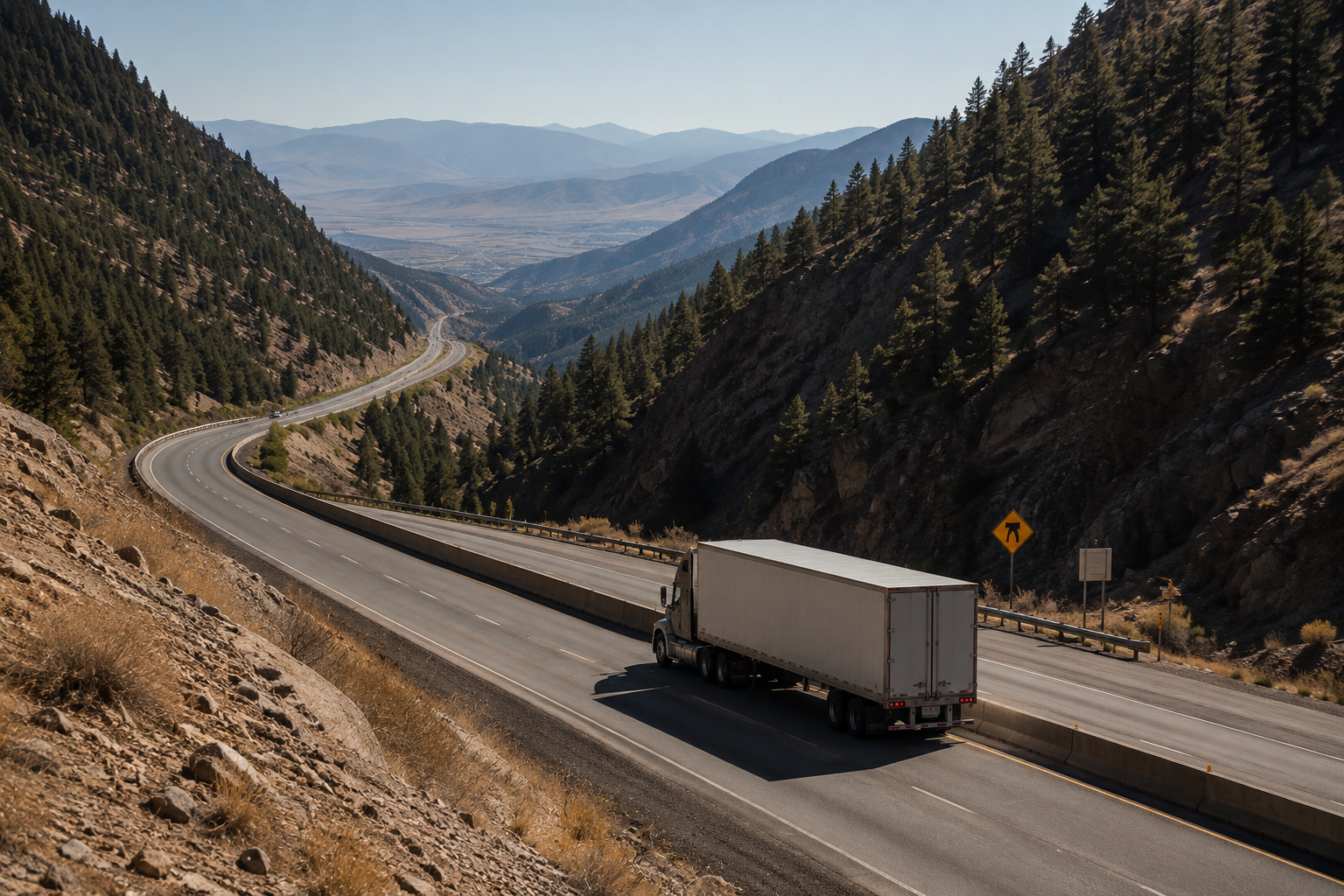
Colorado’s geography gives it trucking laws most states do not need. The I-70 mountain corridor between Denver and the Western Slope combines steep grades, sharp curves, high altitude, and fast-changing weather. Runaway truck ramps on the descent from the Eisenhower Tunnel exist because brake fade on those grades is a known, recurring danger.
Colorado backs that reality with its own statute. Commercial vehicles with a weight rating of 16,001 pounds or more must carry tire chains on I-70 between Dotsero and Morrison from September 1 through May 31 each year, and must chain up when the chain law is in effect.[10] A carrier or driver who ignored the chain law before losing control has violated a specific safety statute, which matters when proving negligence.
Along the Front Range, I-25 carries heavy freight through congested urban traffic from Fort Collins through Denver and the Tech Center to Colorado Springs and Pueblo, where truck crashes more often involve following distance, lane changes, and work zones. I-76 carries freight northeast across the plains toward Nebraska, and US 85 moves agricultural and energy traffic through the Weld County corridor. Wherever the crash happened, the local conditions become part of the liability story.
Who Is Liable for a Truck Accident Under Colorado Law
Liability in a tractor-trailer crash often extends well beyond the person behind the wheel. Depending on the facts, responsible parties can include:
- The truck driver, for speeding, distraction, fatigue, impairment, or unsafe maneuvers such as improper lane changes and wide turns.
- The motor carrier, both for its driver’s conduct on the job and for its own failures, such as negligent hiring, inadequate training, unrealistic delivery schedules that encourage hours-of-service violations, or pressuring drivers to skip rest.
- A maintenance provider, when brake failure, tire blowouts, or other mechanical problems trace back to skipped inspections or bad repair work.
- The shipper or cargo loader, when unbalanced or unsecured cargo causes a rollover, a jackknife, or a lost load.
- A parts or vehicle manufacturer, when a defective component contributed to the crash.
- A government entity, in limited cases involving dangerous road conditions, which triggers a strict 182-day written notice requirement that is far shorter than the standard filing deadline.
The type of crash often points to the type of failure. Jackknife and rollover crashes frequently involve speed, braking, or load problems. Underride crashes, where a car slides beneath the trailer, raise questions about lighting, reflective equipment, and guard compliance. Blind spot and wide-turn crashes point to driver training and mirror use. Rear-end crashes on Colorado’s mountain grades often trace back to brake condition and speed management. Each of these crash types has its own liability patterns under the same legal framework, including situations where the trucking company may be legally responsible for the collision.
What the Law Requires Trucking Companies to Record
Commercial trucks generate records that passenger vehicles do not, because federal law requires them, and those records usually decide the case.
Carriers must keep ELD driving logs, driver qualification files, post-crash drug and alcohol testing results, and inspection and maintenance records. The truck’s engine control module also records speed and braking in the seconds before a crash, and many trucks carry dashcams. But the law only requires carriers to keep some of these records for a limited time. ELD logs, for example, generally must be retained for just six months.[2]
None of this evidence is in the injured person’s possession. It belongs to the carrier, and it can be lost, overwritten, or destroyed on routine retention schedules. One of the first steps we take is sending a preservation letter that puts the carrier on legal notice not to destroy evidence, then following up with formal discovery to obtain it.
Injuries and What the Law Lets You Recover
The physics of an 80,000-pound vehicle striking a 4,000-pound one mean truck crash injuries are often catastrophic: traumatic brain injuries, spinal cord damage and paralysis, amputations, severe burns from fuel fires, crush injuries, and internal organ damage. Because Colorado does not cap economic damages, fully documenting decades of future care, lost earning capacity, and long-term support is often the most important part of the claim.
When a crash is fatal, Colorado’s wrongful death laws allow certain family members to bring a claim. Both catastrophic injury and wrongful death claims demand the same thing in a truck case: documenting the complete, long-term cost rather than just the bills that have arrived so far.
How Elkus & Sisson Helps After a Truck Crash
Knowing the law is one thing. Using it against a carrier’s defense team is another. We approach every truck case with the preparation of a trial firm, whether it settles or goes to court.
- Immediate evidence preservation. Sending preservation letters to the carrier and every related company before ELD data, ECM data, and maintenance records disappear.
- Full investigation. Reconstructing the crash, obtaining federal safety records, and identifying every company in the chain of responsibility.
- Regulatory analysis. Reviewing hours-of-service, maintenance, and driver qualification compliance for violations that establish negligence.
- Damages valuation. Working with medical and vocational experts to document lifetime costs, not just current bills.
- Negotiation and litigation. Pursuing a fair settlement and preparing to try the case when a fair offer is not made.
An early, honest read on your case costs nothing and protects your options before the carrier’s insurer sets the terms.
Frequently Asked Questions
How long do I have to file a truck accident lawsuit in Colorado?
Claims arising from the use or operation of a motor vehicle, including semi-truck and tractor-trailer crashes, generally must be filed within three years. If a government entity may share fault, written notice is required within 182 days,[9] a far shorter window. The practical deadline is often sooner than the legal one, because critical carrier records can be destroyed on routine schedules within months of the crash.
Who do I sue after a semi-truck accident, the driver or the company?
Often both, and frequently others. The motor carrier is generally responsible for its driver’s on-the-job negligence, and it can also be directly liable for its own failures in hiring, training, scheduling, or maintenance. Shippers, cargo loaders, maintenance contractors, and brokers can share responsibility depending on the facts. Identifying every liable party matters because it determines the insurance available to pay the claim.
Are truck drivers held to different standards than other drivers?
Yes. Commercial drivers must hold a CDL, follow federal hours-of-service limits, submit to drug and alcohol testing, and operate under a stricter impairment threshold of 0.04 percent blood alcohol, half the limit for other drivers.[4] Their employers must inspect and maintain vehicles under federal rules. Violations of these standards are often central to proving a truck accident claim.
The trucking company's insurer already offered me a settlement. Should I take it?
Be cautious with any early offer. Quick settlements are typically made before the full extent of your injuries and future costs is known, and accepting one ends your claim permanently, even if your condition worsens. Before signing anything, it is worth having an attorney review the offer against the actual long-term cost of your injuries. Elkus & Sisson offers a free consultation for exactly that purpose.
What is my truck accident claim worth?
There is no fixed formula, but truck claims are often worth more than car crash claims for two reasons: the injuries tend to be more severe, and there is usually more insurance available because federal law requires carriers to hold higher coverage. Your claim generally reflects your economic losses, which Colorado does not cap, plus noneconomic losses like pain and suffering, which are capped for most injury claims filed on or after January 1, 2025. Shared fault reduces recovery, which is why the insurer’s version of events should never go unchallenged. Documenting the full long-term cost is what protects the value of the claim.
What evidence should be preserved after an 18-wheeler crash?
The most important records belong to the carrier: electronic logging device data, engine control module data, driver qualification files, drug and alcohol test results, inspection and maintenance records, dispatch records, and any dashcam footage. On your side, keep photos from the scene, witness contact information, medical records, and all correspondence from insurers. A preservation letter from an attorney puts the carrier on legal notice not to destroy its records.
Talk With a Colorado Truck Accident Lawyer
Colorado truck accident laws layer federal regulations over state rules on fault, damages, and deadlines, and the evidence that proves a violation disappears quickly. The sooner the investigation starts, the stronger the claim.
Elkus & Sisson, PC represents people injured in truck crashes throughout Colorado, including the Front Range, the I-70 mountain corridor, and the Denver metro area, from our offices in Greenwood Village.
To review what happened and understand your options, Schedule Free Consultation.

Donald Sisson

Reid Elkus
[1] NHTSA, Traffic Safety Facts 2023 Data: Large Trucks (DOT HS 813 717), Fatality Analysis Reporting System (FARS) |
https://crashstats.nhtsa.dot.gov/Api/Public/ViewPublication/813717
[2] 49 CFR Part 395 (Hours of Service of Drivers; § 395.8(k) Record Retention) |
https://www.ecfr.gov/current/title-49/subtitle-B/chapter-III/subchapter-B/part-395
[3] 49 CFR Part 396 (Inspection, Repair, and Maintenance) |
https://www.ecfr.gov/current/title-49/subtitle-B/chapter-III/subchapter-B/part-396
[4] 49 CFR Part 382 (Controlled Substances and Alcohol Use and Testing; § 382.201 Alcohol Concentration) |
https://www.ecfr.gov/current/title-49/subtitle-B/chapter-III/subchapter-B/part-382
[5] 49 CFR Part 387 (Minimum Levels of Financial Responsibility for Motor Carriers) |
https://www.ecfr.gov/current/title-49/subtitle-B/chapter-III/subchapter-B/part-387
[6] C.R.S. § 13-21-111 (Comparative Negligence as Measure of Damages) |
https://law.justia.com/codes/colorado/title-13/damages-and-limitations-on-actions/article-21/part-1/section-13-21-111/
[7] C.R.S. § 13-21-102.5(3)(a)(II), as amended by HB24-1472 (Limitations on Damages for Noneconomic Loss or Injury) |
https://law.justia.com/codes/colorado/title-13/damages-and-limitations-on-actions/article-21/part-1/section-13-21-102-5/
[8] C.R.S. § 13-80-101 (Three-Year Limitation, Motor Vehicle Actions) |
https://law.justia.com/codes/colorado/title-13/limitation-of-actions/article-80/section-13-80-101/
[9] C.R.S. § 24-10-109 (Colorado Governmental Immunity Act, Notice Required) |
https://law.justia.com/codes/colorado/title-24/administration/article-10/section-24-10-109/
[10] C.R.S. § 42-4-106(5) (Commercial Vehicle Chain Law and I-70 Chain Carry Requirement) |
https://law.justia.com/codes/colorado/title-42/regulation-of-vehicles-and-traffic/article-4/part-1/section-42-4-106/
Client Stories
From the date I contacted Colorado Accident Attorneys I talked to Angela De La Garza I knew I had found a great lawyer. Back in 2019 I needed a Lawyer; for my husband, he had a very bad fall on Nov 27,2019,…
We contacted Colorado Accident Attorneys about a legal issue. My husband’s call was returned promptly. Our experience was five stars all the way through the process. Brad Hansen was the attorney and Angela De La Garza his assistant. Both treated us with…
Schedule a Consultation with a Colorado Truck Accident Attorney
If you or a loved one was injured in a crash with a semi-truck, 18-wheeler, or tractor-trailer anywhere in Colorado, contact Elkus & Sisson, P.C., today. Call 303-529-8552 or reach out online to schedule a free consultation. Our Colorado truck accident attorneys will evaluate what happened, explain your rights under state and federal trucking laws, and act quickly to preserve the evidence your claim depends on.