


Truck Maintenance Failure Accident Lawyer in Colorado



A commercial truck is a machine with thousands of moving parts, and federal law puts the responsibility for keeping those parts safe squarely on the carrier that operates it. When a brake system fails, a tire blows out, or a steering component gives way, the crash that follows is rarely a random mechanical accident. More often, it traces back to a repair that was deferred, an inspection that was skipped, or a warning sign that a driver or mechanic flagged and nobody fixed.
Elkus & Sisson, P.C. investigates the maintenance and inspection history behind truck accidents caused by brake, tire, and equipment failures. As Colorado truck accident attorneys, we request the carrier’s repair records, inspection reports, and driver logs to determine whether a mechanical failure was foreseeable and preventable, not an unavoidable accident.
Brake Failures
Federal law requires every commercial truck to have brakes adequate to stop and hold the vehicle, meeting specific service, parking, and emergency brake standards under .[1] Brake failures in truck accidents usually involve worn linings or pads that were not replaced, an imbalanced brake system across axles, or a maintenance shortcut such as skipping a required brake adjustment. Because commercial trucks rely on air brake systems with multiple interdependent components, a single neglected part can affect the entire truck’s ability to stop.
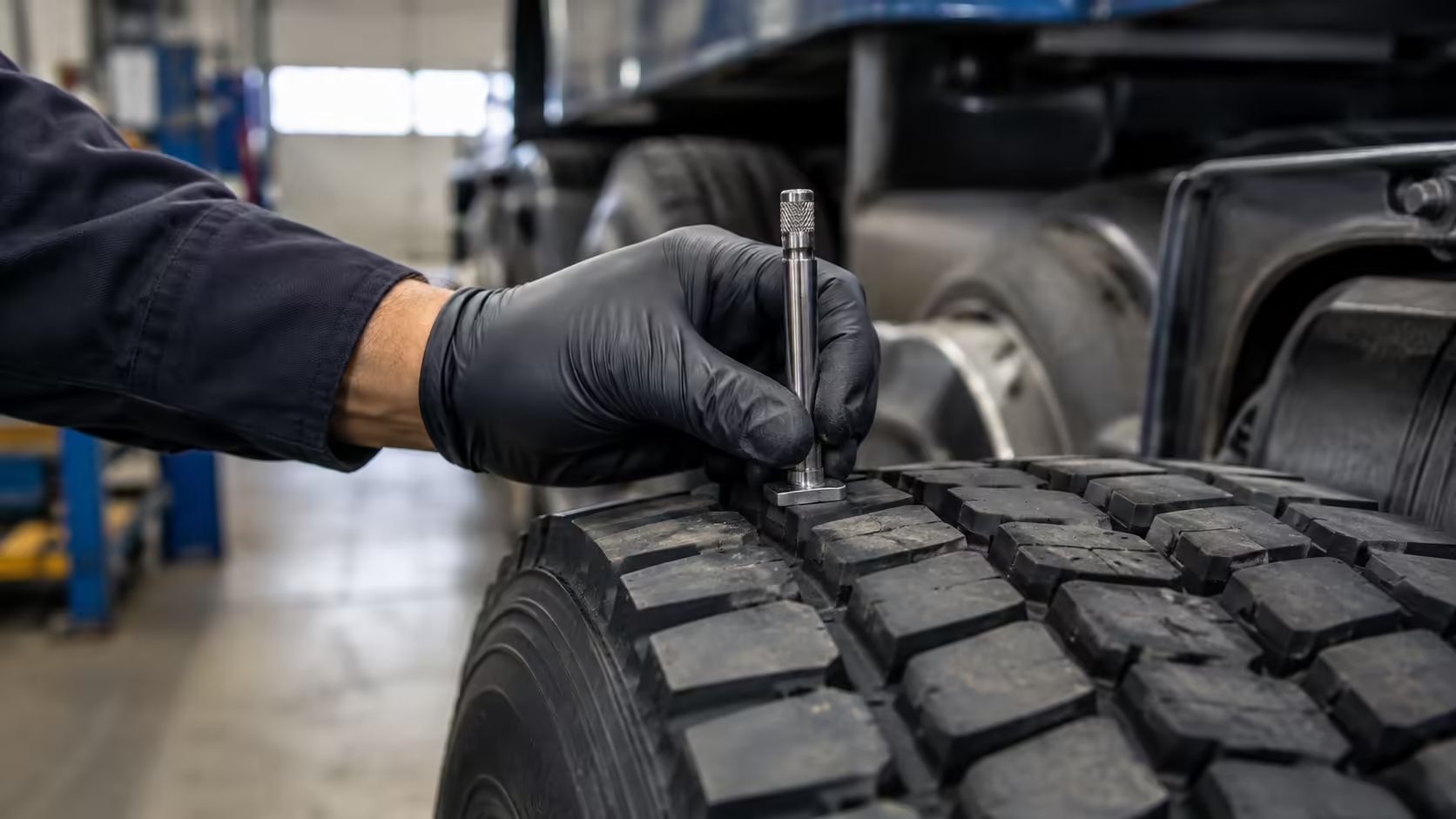
Tires
Tires are one of the most commonly cited maintenance failures in truck crashes. Federal regulations set a minimum tread depth of 4/32 of an inch on steer tires and 2/32 of an inch on all other tires.[2] A tire below either threshold, or one with exposed cord or belt material, is not just a maintenance lapse. It is a violation the carrier is responsible for catching, whether through a driver’s pre-trip inspection or the carrier’s own maintenance schedule. Tread separation, blowouts, and loss of control on wet or icy roads are frequent consequences of tires that should have been replaced before the truck left the yard.
Inspections
Every commercial truck must pass a periodic inspection at least once every 12 months, covering brakes, tires, steering, suspension, and other safety-critical systems under .[3] Drivers are also required to complete a written inspection report after each day of driving, noting any defect or deficiency that could affect safety. A passed annual inspection is not the end of the story. It only confirms the truck’s condition on the day it was inspected, and problems that develop or worsen afterward are the carrier’s responsibility to catch through ongoing driver reports and routine maintenance.
Repair Logs
Motor carriers are required to systematically inspect, repair, and maintain every truck under their control, and to keep records identifying the vehicle and documenting the date and nature of every inspection, repair, and maintenance operation performed, under [4]. These maintenance files often show whether a known problem, such as a driver’s noted brake issue or a tire flagged as worn, was actually addressed or simply carried forward from one inspection to the next.
These records do not last indefinitely. General maintenance files must be kept for one year, plus six months after the truck leaves the carrier’s control, while daily driver inspection reports need only be retained for three months from the date they were written.[5] Both retention periods are considerably shorter than the three years Colorado generally allows to file a truck accident lawsuit, which means the records that could prove a maintenance failure can be lawfully discarded long before a case would otherwise need to go to court.
Carrier Duties
A maintenance failure claim comes down to three things: the duty the carrier owed, whether a violation can count as negligence, and what happens if the proof goes missing.
A Federal Duty
A motor carrier’s duty to maintain its trucks comes from federal safety law, not internal company policy. When a violation of that duty, such as operating with tires below the legal tread depth or ignoring a documented brake defect, causes the type of harm the regulation was meant to prevent, Colorado law allows that violation to serve as evidence of negligence.
Negligence Per Se
Colorado’s negligence per se doctrine, recognized by the Colorado Supreme Court, treats a defendant’s violation of a safety regulation as evidence of a breach of duty, but only if the injured person belongs to the class the regulation protects and suffered the type of harm it was meant to prevent.[6][7] Motor vehicle safety regulations governing brakes, tires, and inspections exist to protect everyone on the road, including the people injured when a poorly maintained truck fails to stop or loses control.
Lost or Destroyed Records
If a repair file was lost or destroyed after the carrier knew or should have known that litigation was likely[8], Colorado courts can sanction the carrier for that loss. Typically, that means letting the jury assume the missing records would have supported the injured person’s claim.
Because a maintenance failure often implicates the carrier directly, not just the driver, these cases frequently connect to broader questions of trucking company liability, including whether the carrier’s own policies or cost pressures contributed to deferred repairs.
Statute of Limitations for Truck Accident Claims in Colorado
Colorado law generally gives you three years from the date of a truck accident to file a lawsuit for the resulting injuries or property damage.[9] Missing this deadline can permanently bar your claim regardless of how strong the evidence is. If a government entity may be a defendant, or if the injured person was a minor at the time of the crash, different notice periods and tolling rules may apply and should be confirmed early. This filing deadline is separate from the maintenance record retention periods discussed above, and it is considerably longer, which is exactly why the records tend to disappear well before the lawsuit deadline does.
What an Attorney Does to Investigate a Maintenance Failure
Investigating a maintenance failure claim starts with identifying what records exist and moving to secure them. An attorney can:
- Send a written preservation request to the carrier and its insurer identifying the specific truck and requesting its maintenance file, driver inspection reports, and annual inspection records
- Compare the driver’s daily inspection reports against the carrier’s repair records to identify gaps, delays, or ignored defects
- Retain a qualified mechanical or accident reconstruction expert to evaluate whether the failure was consistent with normal wear or with deferred maintenance
- Pursue formal discovery, a subpoena, or a court order if the carrier does not produce records voluntarily once a lawsuit is filed
What Maintenance Records Can Show About Negligence
A truck that was properly inspected and maintained rarely loses its brakes or throws a tire on the open highway. When one does, the maintenance file often explains exactly why, if it still exists when you ask for it.
What a maintenance file can show. A pattern of deferred repairs, a skipped brake adjustment, or a tire replaced past its wear limit can turn a mechanical failure into documented carrier negligence rather than an accident nobody could have prevented, foreseen, or stopped in time.
Why the records do not last as long as your claim does. Colorado gives you three years to sue over a truck accident, but a carrier only has to keep general maintenance records for about a year after a truck leaves its fleet, and daily inspection reports for as little as three months.
Where inspections and repair logs diverge. A passed annual inspection does not rule out negligence if the carrier deferred a known brake or tire issue soon afterward, which is why the full repair history matters more than a single clean inspection report standing on its own.
What a missing maintenance record can mean. If a carrier destroys or loses a repair file after it knew a lawsuit was likely, Colorado law allows a court to treat that gap as evidence against the carrier rather than against the person who was actually hurt in the crash itself.
The more complete the inspection and repair history an attorney can obtain, the clearer the picture becomes of whether this crash was unavoidable or the result of deferred maintenance.
[1] 49 C.F.R. § 393.40: Required Brake Systems | https://www.ecfr.gov/current/title-49/subtitle-B/chapter-III/subchapter-B/part-393/subpart-C/section-393.40
[2] 49 C.F.R. § 393.75: Tires (tread depth requirements) | https://www.ecfr.gov/current/title-49/subtitle-B/chapter-III/subchapter-B/part-393/subpart-G/section-393.75
[3] 49 C.F.R. § 396.17: Periodic Inspection | https://www.ecfr.gov/current/title-49/subtitle-B/chapter-III/subchapter-B/part-396/section-396.17
[4] 49 C.F.R. § 396.3: Inspection, Repair, and Maintenance (carrier duty and records) | https://www.ecfr.gov/current/title-49/subtitle-B/chapter-III/subchapter-B/part-396/section-396.3
[5] 49 C.F.R. § 396.11: Driver Vehicle Inspection Report(s) | https://www.ecfr.gov/current/title-49/subtitle-B/chapter-III/subchapter-B/part-396/section-396.11
[6] Largo Corp. v. Crespin, 727 P.2d 1098 (Colo. 1986): Colorado negligence per se doctrine | https://law.justia.com/cases/colorado/supreme-court/1986/84sc365-0.html
[7] Canape v. Petersen, 897 P.2d 762, 763–64 (Colo. 1995): class-of-persons and type-of-harm test | https://law.justia.com/cases/colorado/supreme-court/1995/94sc230-0.html
[8] Terra Management Group, LLC v. Keaten, 2025 CO 40 (Colo. 2025): duty to preserve evidence and spoliation standard | https://www.coloradojudicial.gov/system/files/opinions-2025-06/23SC272.pdf
[9] C.R.S. § 13-80-101(1)(n): Colorado Revised Statutes, three-year limitation period for motor vehicle actions | https://law.justia.com/codes/colorado/title-13/limitation-of-actions/article-80/section-13-80-101/
Frequently Asked Questions
What counts as a maintenance failure in a truck accident case?
A maintenance failure is a mechanical problem that a carrier should have caught or fixed through routine inspection and repair, such as worn brake linings, tires below the legal tread depth, a cracked wheel, or a steering or suspension defect. These differ from sudden, unforeseeable part failures because they usually leave a paper trail of missed or deferred maintenance in the truck’s own records.
Who is responsible for keeping a commercial truck properly maintained?
The motor carrier that controls the truck is responsible for systematically inspecting, repairing, and maintaining it, along with the drivers who complete daily inspection reports. Responsibility can extend to a leasing company or a separate maintenance contractor if that party actually handled the truck’s upkeep, so identifying every party involved in maintaining the vehicle is part of investigating the claim.
Can a passed inspection still mean the carrier was negligent?
Yes. An annual inspection reflects the truck’s condition on a single day, not a promise that nothing will fail afterward. A carrier that skips a recommended repair, ignores a driver’s inspection report, or lets a known issue go unaddressed after a passing inspection can still be negligent for what happened later.
How can an attorney get a trucking company's maintenance records?
An attorney typically starts with a written request or preservation letter to the carrier and its insurer, then uses formal discovery, including subpoenas, if the carrier does not produce the records voluntarily once a lawsuit is filed. Because federal law only requires carriers to keep these records for a limited time, requesting them without unnecessary delay improves the chances they still exist.
Client Stories
From the date I contacted Colorado Accident Attorneys I talked to Angela De La Garza I knew I had found a great lawyer. Back in 2019 I needed a Lawyer; for my husband, he had a very bad fall on Nov 27,2019,…
We contacted Colorado Accident Attorneys about a legal issue. My husband’s call was returned promptly. Our experience was five stars all the way through the process. Brad Hansen was the attorney and Angela De La Garza his assistant. Both treated us with…
Top Rated Lawyers in the State of Colorado


Talk to a Colorado Truck Accident Lawyer About a Maintenance Failure
A truck accident caused by a brake, tire, or equipment failure often points back to a decision the carrier made, or failed to make, long before the crash. At our Colorado office locations, Elkus & Sisson, P.C. represents people injured in commercial truck accidents across Denver, Greenwood Village, Lakewood, Aurora, and Boulder.
If you were hurt in a truck accident and suspect a maintenance or inspection failure was involved, contact us or call +1 303-567-7981 to schedule a consultation about your case.
Schedule Consultation