


Common Semi-Truck Accident Injuries and Their Long-Term Effects


Common semi-truck accident injuries include traumatic brain injuries, spinal cord and back injuries, broken bones, internal bleeding, crush injuries and amputations, burns, and soft tissue injuries such as whiplash. Some heal fully with treatment, while others need months or years of care.
How badly someone is hurt depends on how the crash happened, the speed and point of impact, and the person’s age, health, and position in the vehicle.
This guide explains each injury type, its possible long-term effects, why medical records matter, and how injuries fit into a Colorado claim. It is general information, not medical advice, and only a treating provider can diagnose an injury or recommend care.
Why Are Semi-Truck Accident Injuries Often More Severe Than Car Crash Injuries?
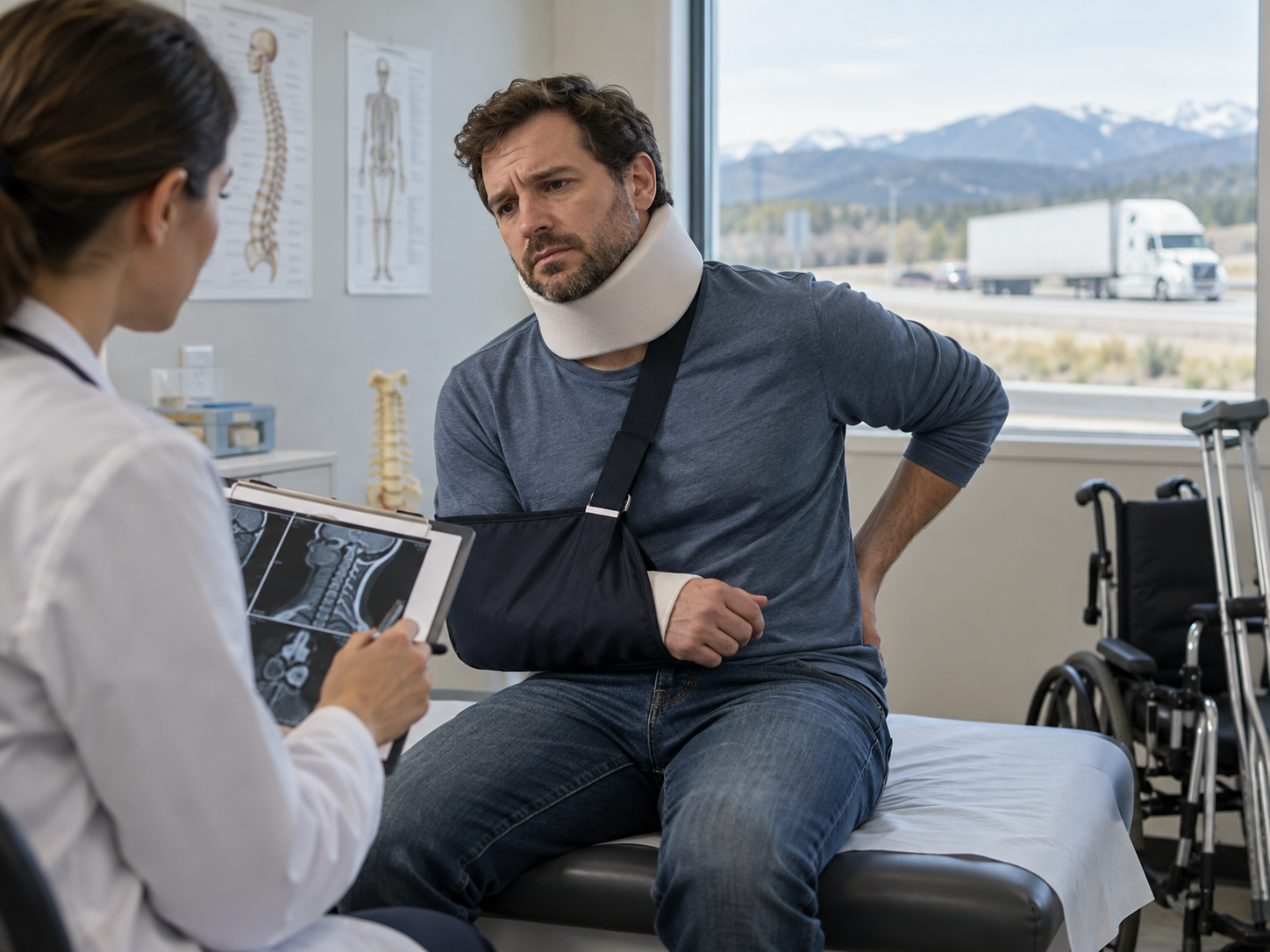
Semi-truck accident injuries are often more severe than car crash injuries because a large truck is much heavier and taller than a passenger vehicle and takes longer to stop when it is loaded. Our guide to Colorado truck accident laws covers the rules on fault, damages, and deadlines.
The main physical factors are:
- Weight. The heaviest large trucks can weigh 20 to 30 times as much as a passenger car. The Insurance Institute for Highway Safety (IIHS) says the main problem is how vulnerable people in smaller vehicles are.[1]
- Stopping distance. Loaded tractor-trailers need 20 to 40 percent more distance than cars to stop, and the gap grows on wet or slippery roads or with poorly maintained brakes.
- Height and underride. Trucks sit taller and have more ground clearance, which can allow a smaller vehicle to slide underneath in a crash.
- Impact direction and speed. Head-on, side, and rear impacts affect the body differently, and higher speeds generally mean more force for the vehicles and the people inside to absorb.
- Crash type and what follows. Rollovers, jackknife crashes, secondary collisions, and fires can add injuries beyond the first impact.
- Occupant protection. Seat belts, airbags, and a vehicle’s crash structure can reduce injury. Their absence or failure can increase it.
According to the National Highway Traffic Safety Administration (NHTSA), 5,340 people were killed and an estimated 161,201 were injured in crashes involving large trucks in 2024. The figures cover every truck rated above 10,000 pounds, not only tractor-trailers.
Most of those people were not in the truck. About 70 percent of those killed and 72 percent of those injured were occupants of other vehicles, and 105 of the deaths happened in Colorado.[2]
None of this means a particular crash will cause a severe injury. Some people walk away from a truck crash with only minor harm. Even so, any injury after a truck crash should be evaluated rather than assumed to be minor.
Common Injuries in Semi-Truck Accidents
A single semi-truck crash can cause more than one of the injuries below, and some are not obvious at the scene.
Traumatic Brain Injuries
A traumatic brain injury (TBI) is an injury to the brain caused by an outside force, such as a forceful bump, blow, or jolt to the head or body. Not every blow to the head causes one.
In a closed head injury, the force is strong enough to move the brain inside the skull. Motor vehicle crashes are one of the causes.[3]
A concussion is a mild form of TBI. Symptoms vary from person to person and can affect how someone feels, thinks, acts, or sleeps. Some show up right away, and others may not appear for hours or days.
The Centers for Disease Control and Prevention (CDC) says most people with a concussion feel better within a couple of weeks.[4] The National Institute of Neurological Disorders and Stroke (NINDS) notes that healing can take anywhere from minutes to several months.
More serious TBIs can have longer-lasting effects. Some cause temporary problems with thinking, movement, or communication. The more serious ones can lead to severe and permanent disability. The size, severity, and location of the injury all affect recovery.
Danger signs. The CDC says to get emergency care right away if any of these signs appear, among others:
- A headache that gets worse and does not go away
- Repeated vomiting
- Slurred speech
- One pupil that is larger than the other
This is not a complete list, and only a medical evaluation can rule out a brain injury.
Spinal Cord and Back Injuries
Back and neck pain after a crash can come from several kinds of injury, and pain alone does not show which one. X-rays, CT scans, and MRI help doctors tell them apart.[5]
- Spinal cord injury. Damage to the spinal cord, or to the bones and tissue around it, can change feeling, movement, strength, and body functions below the injury, sometimes permanently. An injury is incomplete when some function remains and complete when none does. Motor vehicle accidents are among the most common causes.
- Vertebral fractures. A broken vertebra is a bone injury that may or may not involve the spinal cord. X-rays and CT scans can show a fracture or misalignment of the vertebrae.
- Disc injuries. The cushioning discs between the bones of the spine can herniate, which means part of the disc pushes out of its normal position. An MRI can show herniated discs and injury to the ligaments that support the neck.
- Muscle and ligament injuries. Sprains and strains of the back and neck are soft tissue injuries and do not involve the spinal cord itself. Recovery varies from person to person.
Outcomes after a spinal cord injury range widely. NINDS notes that some injuries cause little or no nerve cell death and may allow an almost complete recovery. In a complete injury, sensation and movement below the injury are lost.
Broken Bones and Orthopedic Injuries
A fracture is a break in a bone, and car accidents are a common cause.[6] In a truck crash, bones can break when the body hits the inside of the vehicle or is pinned by crushed parts of it.
The most common treatment is a cast or splint. Some fractures need surgery to place plates, pins, or screws that hold the bone in place.
If you think a bone may be broken, MedlinePlus advises getting medical care right away. How long a cast or splint is needed depends on the fracture and the bone. Whether a fracture will cause lasting stiffness or pain is a question for the treating provider.
Internal Organ Injuries and Internal Bleeding
Blunt trauma, such as being thrown into a steering wheel or squeezed between hard surfaces in a crash, can cause internal bleeding. That bleeding may not show up until hours or days after the injury, so feeling fine at the scene does not rule out an internal injury.[7]
Even seemingly minor trauma can cause internal bleeding, and it can be life-threatening. Only a medical evaluation can show whether an internal injury is present.
Crush Injuries and Amputations
A crush injury happens when part of the body is under prolonged pressure or compression, for example when the vehicle collapses around an occupant. It can cause muscle injury and swelling, possible muscle death, and nerve problems in the affected area.[8]
In severe cases, a crush injury can lead to crush syndrome, which affects the whole body after extensive muscle damage. It can involve kidney injury, heart failure, and shock, and doctors can overlook it when a person has several injuries at once.[9]
A limb can be lost at the scene of a severe crash or may need to be amputated during treatment. Traffic accidents are among the traumatic injuries that can cause limb loss.
A prosthesis, or artificial limb, can sometimes replace a missing limb and help with daily activities such as walking, eating, or dressing.[10] Outcomes vary widely from person to person.
Burn Injuries
Burns can result from flames, hot surfaces or liquids, and chemicals, and a crash that ignites fuel or releases hazardous cargo can expose people to those hazards.
Doctors describe burns by how deep they go. A first-degree burn damages only the outer layer of skin. A second-degree burn damages the outer layer and the layer beneath it. A third-degree burn damages or destroys both layers, and deeper burns can reach fat, muscle, or bone.
Third-degree burns do not heal on their own, so skin grafting, which means moving healthy skin to the burned area, is often needed.
A burn that heals within about 14 days typically does not scar. The longer a wound stays open, the greater the risk of scarring. A burn’s size, location, and other factors also affect how serious it is.[11]
Soft Tissue and Neck Injuries
Soft tissue injuries affect muscles and ligaments rather than bone. Whiplash, also called a neck sprain or strain, is a soft tissue injury to the neck. Accidents, including car accidents, are a common cause of neck pain.[12]
Treatment depends on the cause. It may include ice, pain relievers, physical therapy, or a neck brace called a cervical collar, and surgery is rarely needed. Recovery varies from person to person, so a soft tissue injury should not be assumed to be minor.
What Are the Possible Long-Term Effects of Truck Crash Injuries?
Not every truck crash injury leads to the lasting effects below. That depends on the diagnosis, how severe the injury is, and how the person responds to treatment. Recovery can also vary among people with the same diagnosis.
- Extended medical treatment. Follow-up surgery, specialist care, medication, and imaging over months or years.
- Rehabilitation. Physical, occupational, speech, or vocational therapy to help rebuild function.
- Functional limitations. Problems with how a person thinks, understands, moves, or communicates that affect daily tasks.
- Changes in work capacity. Time away from work, work restrictions, or in some cases a reduced ability to do the same job. Vocational rehabilitation can help identify what a person can do and what workplace changes may be needed.
- Chronic pain. Persistent pain that a provider documents and connects to a diagnosed condition. Some people with spinal cord nerve damage develop ongoing nerve pain.
- Adaptive equipment. Wheelchairs, walkers, prosthetics, computer adaptations, or other assistive devices.
Care needs can differ even within one diagnosis. For example, about one-third of those with a spinal cord injury in the neck will need temporary or permanent help with breathing, while a lower injury may affect the legs and lower body instead.
The table below gives a general picture of the outcomes reported in the sources cited here. Only a treating provider can say where a specific injury falls within these ranges.
General range of outcomes by injury category (general information only)
|
Injury category |
General range of outcomes (varies by person) |
|
Concussion (mild TBI) |
Most people feel better within a couple of weeks; healing can take from minutes to several months |
|
Brain injury beyond concussion |
Temporary or short-term problems with thinking, movement, or communication, up to severe and permanent disability |
|
Spinal cord injury |
Almost complete recovery when little nerve damage occurs, up to loss of sensation and movement below the injury in a complete injury |
|
Fractures |
Often treated with a cast or splint; some need surgery with plates, pins, or screws |
|
Internal injuries |
Can be life-threatening; signs may not appear for hours or days |
|
Crush injuries and limb loss |
Local muscle and nerve injury; crush syndrome can affect the whole body; a prosthesis can sometimes replace a lost limb |
|
Burns |
From burns that heal without scarring to deeper burns that may need skin grafts |
|
Whiplash and soft tissue |
Treated without surgery in most cases; recovery time varies |
Why Is Medical Documentation Important After a Truck Accident?
Medical records show what your injuries are, how they were treated, and how they affect daily life. That is why they matter so much to a claim. Records can document:
- Diagnoses. What the provider found and named.
- Treatment dates. When care began and how consistently it continued.
- Diagnostic findings. Imaging, lab results, and examination findings.
- Rehabilitation. Therapy notes showing progress, plateaus, or setbacks.
- Medical expenses. Bills showing what the care cost.
- Functional limitations. Work restrictions and notes about daily activities.
- Recommended future care. Provider opinions on further surgery, therapy, or equipment.
Medical evidence is not proof of fault. Records can show that a person was hurt and help link the injuries to the crash, but they do not show who caused it. That proof comes from other evidence, such as driver logs, vehicle data, and witness accounts.
Your providers decide diagnosis and treatment. A lawyer’s job is to look at how documented injuries relate to the crash and to a possible claim, not to decide what care you need. No one should have tests or procedures they do not medically need just to support a claim.
Gaps in treatment can raise questions. A delay in care or a long break in treatment does not mean an injury is not real, but the other side may ask why. Getting evaluated when symptoms appear and following your provider’s recommended care helps the record show what actually happened.
How Do Injuries Affect a Colorado Truck Accident Claim?
Injuries define the losses in a claim, but they do not establish liability, which means legal responsibility. Liability depends on proof that another party’s negligence caused the crash and the injuries. When that is proven, documented injuries may support recovery of:
- Medical expenses. Reasonable and necessary medical, hospital, and other expenses for crash-related treatment.
- Future treatment costs. Care the evidence shows the person will probably need it in the future, such as surgery, therapy, or equipment.
- Lost income. Earnings lost because of the injury.
- Reduced earning capacity. A reduced ability to earn money in the future.
- Noneconomic damages. Harm that is not a financial cost, including pain and suffering, inconvenience, emotional stress, and impairment of the quality of life. Colorado limits this category by statute.[13]
What a claim may be worth depends on who is legally responsible, the evidence, the available insurance, and Colorado law. Our guide to truck accident settlement factors covers how these work, including how a share of fault can reduce or bar recovery.
Filing deadlines. A lawsuit for bodily injury from a truck crash generally must be filed within three years.[14] Some claims follow different deadlines or notice rules.
When Do Truck Crash Injuries Support a Catastrophic or Wrongful Death Claim?
A truck crash injury may support a catastrophic injury claim when it permanently changes how a person lives, such as a severe brain injury, a spinal cord injury, serious burns, or the loss of a limb. These claims focus on lifetime costs, such as ongoing care and lost earning capacity.
When a person dies from injuries caused by a truck crash, Colorado law allows certain survivors, such as a spouse or children, to bring a wrongful death claim. The law sets who may file and in what order.[15]
Client Stories
— Wayne N.
From the date I contacted Colorado Accident Attorneys I talked to Angela De La Garza I knew I had found a great lawyer. Back in 2019 I needed a Lawyer; for my husband, he had a very bad fall on Nov 27,2019,…
We contacted Colorado Accident Attorneys about a legal issue. My husband’s call was returned promptly. Our experience was five stars all the way through the process. Brad Hansen was the attorney and Angela De La Garza his assistant. Both treated us with…
Top Rated Lawyers in the State of Colorado

Talk With a Colorado Truck Accident Attorney
If you were hurt in a crash with a commercial truck, our attorneys at Elkus & Sisson, P.C. can review how the crash happened, what your medical records show, and what legal options may be available to you.
Medical records describe the injuries, but other evidence, such as driver logs and vehicle data, explains how the crash happened.
The firm represents injured people across Colorado from our office.
Call 303-567-7981 or contact us online to schedule a truck accident consultation.
Sources
- [1] Insurance Institute for Highway Safety, Fatality Facts 2024: Large trucks (heaviest trucks can weigh 20 to 30 times as much as passenger cars; vulnerability of people in smaller vehicles; 20 to 40 percent longer stopping distance; ground clearance and underride) | https://www.iihs.org/research-areas/fatality-statistics/detail/large-trucks
- [2] National Highway Traffic Safety Administration, Traffic Safety Facts: Large Trucks, 2024 Data, DOT HS 813 816 (June 2026) (5,340 people killed and an estimated 161,201 injured in crashes involving large trucks, defined as vehicles rated above 10,000 pounds; 70 percent of those killed and 72 percent of those injured were occupants of other vehicles; 105 deaths in Colorado; 2024 counts come from the Annual Report File and can be revised) | https://rosap.ntl.bts.gov/view/dot/91904/dot_91904_DS1.pdf
- [3] National Institute of Neurological Disorders and Stroke, Traumatic Brain Injury (TBI), NIH Publication 25-NS-2478 (July 2025) (definition; closed head injury and motor vehicle crashes; range of effects; concussion healing time; factors that influence recovery; rehabilitation team) | https://www.ninds.nih.gov/sites/default/files/2025-07/NINDS_TBI_Booklet_Digital_508c.pdf
- [4] Centers for Disease Control and Prevention, Symptoms of Mild TBI and Concussion (reviewed September 15, 2025) (symptom variability; delayed onset; typical recovery; danger signs) | https://www.cdc.gov/traumatic-brain-injury/signs-symptoms/index.html
- [5] National Institute of Neurological Disorders and Stroke, Spinal Cord Injury: Hope Through Research (archived page, last reviewed February 16, 2023) (definition; complete and incomplete injury; common causes; imaging tests; breathing complications of neck injuries; rehabilitation and adaptive devices; neurogenic pain) | https://www.ninds.nih.gov/archived/health-information/patient-caregiver-education/hope-through-research/spinal-cord-injury-hope-through-research
- [6] MedlinePlus, Fractures (updated May 14, 2024) (car accidents as a common cause; cast or splint as the most common treatment; surgery with plates, pins, or screws in some cases; seek care right away) | https://medlineplus.gov/fractures.html
- [7] American Red Cross, Bleeding (Life-Threatening Internal) (blunt trauma and crushing forces as causes; signs may not appear until hours or days later) | https://www.redcross.org/take-a-class/resources/learn-first-aid/bleeding-life-threatening-internal
- [8] Bhaumik et al., Crush Syndrome Diagnosis and Management in Resource-Constrained Settings: A Delphi Study, PLoS ONE 2025 (PMC12404363) (consensus definitions of crush injury and crush syndrome; high index of suspicion in polytrauma) | https://www.ncbi.nlm.nih.gov/pmc/articles/PMC12404363/
- [9] Crush Syndrome: A Review for Prehospital Providers and Emergency Clinicians, J Transl Med 2023 (PMC10472640) (cardiac failure, kidney dysfunction, and shock in crush syndrome) | https://www.ncbi.nlm.nih.gov/pmc/articles/PMC10472640/
- [10] MedlinePlus, Artificial Limbs (updated September 23, 2025) (traumatic injuries, including traffic accidents, as a cause of limb loss; prosthesis and daily activities) | https://medlineplus.gov/artificiallimbs.html
- [11] Model Systems Knowledge Translation Center, Understanding a Burn Injury (reviewed 2023) (causes; degrees; skin grafting for third-degree burns; scarring risk and healing time; factors in severity) | https://msktc.org/burn/factsheets/understanding-burn-injury
- [12] MedlinePlus, Neck Injuries and Disorders (whiplash as a soft tissue injury; accidents as a cause; treatment options; surgery rarely needed) | https://medlineplus.gov/neckinjuriesanddisorders.html
- [13] Colorado Judicial Department, Model Civil Jury Instructions, Chapter 6 (Damages), Personal Injuries (economic losses include loss of earnings, damage to the ability to earn in the future, and reasonable and necessary medical, hospital, and other expenses; physical impairment and disfigurement as a separate category; noneconomic limit set by C.R.S. 13-21-102.5) | https://coloradojudicial.gov/media/8628
- [14] C.R.S. 13-80-101(1)(n)(I) and (II) (three-year limitation for tort actions for bodily injury arising out of the use or operation of a motor vehicle; exception for strict liability and failure-to-warn actions) | https://colorado.public.law/statutes/crs_13-80-101
- [15] C.R.S. 13-21-201(1) (Colorado Wrongful Death Act; who may bring an action for damages for death and in what order) | https://colorado.public.law/statutes/crs_13-21-201
Schedule Consultation