


Truck Black Box Data After Accident in Colorado



Semi-trucks and other large commercial vehicles often carry a device that records what the truck was doing in the moments before a crash, including how fast it was moving, whether the driver braked, and how hard the impact was. People call this the truck’s black box. After a serious truck accident, that data is often the clearest account of what happened, more reliable than a police report pieced together from skid marks and secondhand statements. The problem is speed. Depending on how the truck’s system is configured and how the vehicle is used afterward, that record can be partially or fully overwritten within days.
Elkus & Sisson, P.C. represents people who were hurt in crashes with commercial trucks, and black box evidence is often the first thing we move to secure. As Colorado truck accident attorneys, we work with accident reconstruction specialists to identify what data exists, request it before it disappears, and use it to establish what actually happened on the road.
What a Truck’s Black Box Actually Records
‘Black box’ is not an official term. It usually refers to a truck’s engine control module (ECM), and on some newer trucks, a separate event data recorder (EDR) that works alongside it. Depending on the equipment installed, this system can capture:
- Vehicle speed in the seconds before the crash
- Whether and when the brakes were applied
- Throttle position and engine RPM
- Hard-braking or sudden-deceleration events
- Cruise control status
- Fault codes tied to mechanical issues
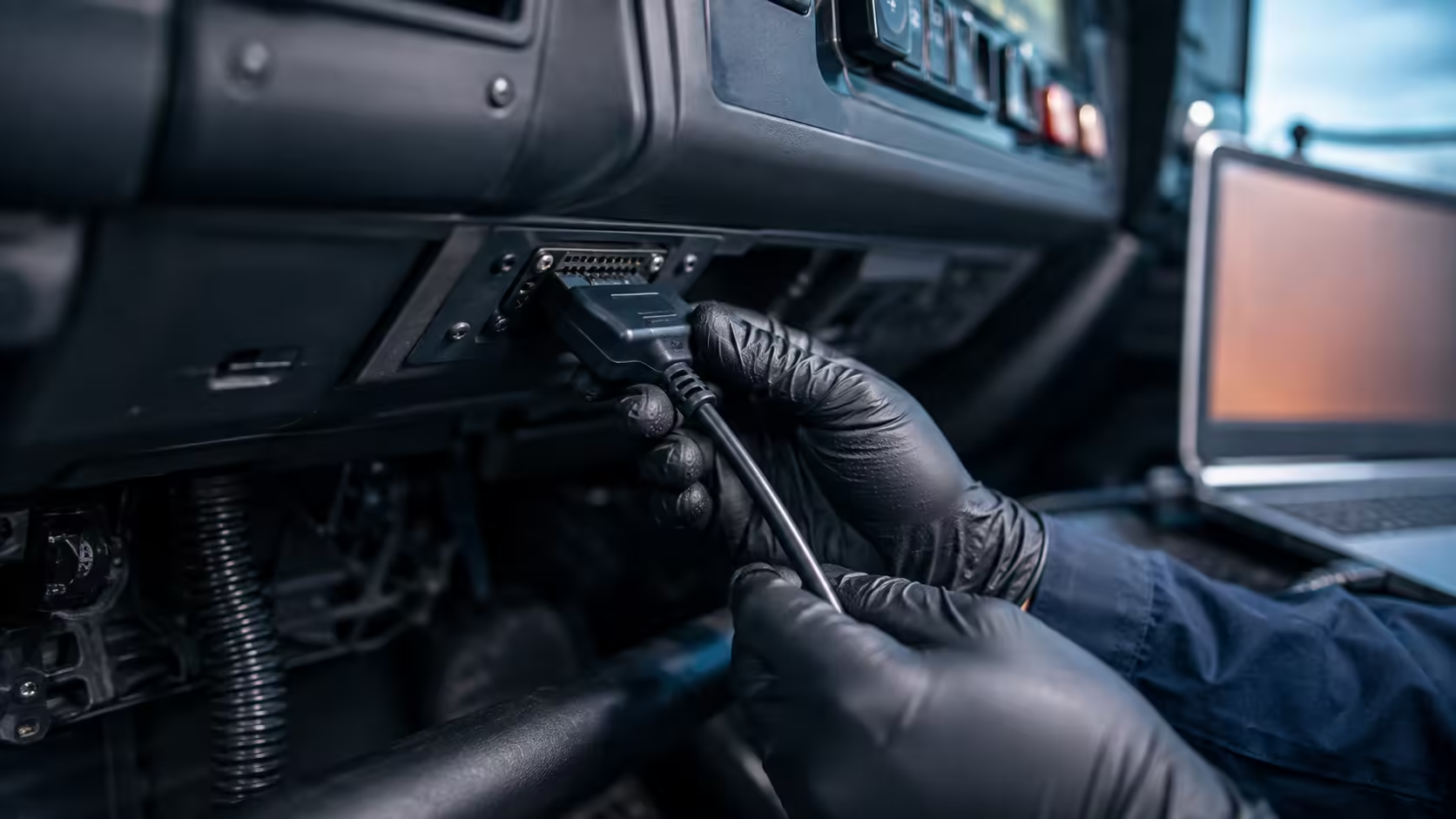
Unlike passenger cars, there is no federal rule requiring commercial trucks to carry an event data recorder or dictating what it must capture. The federal Event Data Recorders standard, 49 C.F.R. Part 563, applies only to light vehicles with a gross vehicle weight rating of 8,500 pounds or less.[2] Most semis and tractor-trailers weigh well beyond that. Heavy-duty recorders are commonly built to a voluntary industry standard, SAE J2728, rather than a binding federal rule. In practice, this means what a specific truck recorded, and in what format, depends on its make, model, and the carrier’s own equipment, not a uniform federal standard.
Why Fast Preservation Matters
Because there is no federal mandate governing how long a truck must keep this data, the carrier and its insurer effectively control it once a crash happens. Depending on the system, older recordings can be overwritten the next time the truck brakes hard, reaches a certain speed, or simply logs enough additional miles. A module’s data can also be affected by a post-crash inspection, a routine repair, or the truck being pulled back into service before anyone downloads it.
Trucking companies and their insurers know this, and many begin their own investigation within hours of a serious crash, often before the people who were hurt have left the hospital. Colorado generally gives you three years to file a truck accident lawsuit, but that filing deadline has nothing to do with how long the black box data will still exist. The record that could show what the driver and the truck were doing before impact can disappear quickly, long before that three-year window closes. That gap, not any manufactured deadline, is why contacting an attorney soon after a crash matters more here than it does in most personal injury cases.
Statute of Limitations for Truck Accident Claims in Colorado
Colorado law generally gives you three years from the date of a truck accident to file a lawsuit for the resulting injuries or property damage.[3] Missing this deadline can permanently bar your claim regardless of how strong the evidence is. If a government entity may be a defendant, such as a claim involving a public transit vehicle or a dangerous road condition, written notice must generally be filed within 182 days under the Colorado Governmental Immunity Act, a far shorter window than the three-year deadline.[4] The clock may also be tolled if the injured person was a minor at the time of the crash.[5] Even with years left to file a lawsuit, the truck’s recorded data can already be gone.
Spoliation of Black Box Data Under Colorado Law
Once a trucking company or its insurer knows, or reasonably should know, that a lawsuit over the crash is likely, Colorado law requires it to preserve evidence relevant to that claim. Losing or destroying that evidence afterward is called spoliation. Colorado courts do not recognize spoliation as its own lawsuit.[6] Instead, a judge can sanction the party responsible, most often by instructing the jury that it may assume the missing evidence would have been unfavorable to that party’s case.
The Colorado Supreme Court addressed exactly when this duty to preserve begins in a 2025 decision, holding that a party must preserve evidence once it knew or should have known that litigation was pending or reasonably foreseeable, and that the evidence was relevant to it.[7] Whether litigation was reasonably foreseeable is decided on the full set of facts, not just on whether a lawsuit had already been filed. For a truck accident, that inquiry often turns on how serious the crash was, how quickly the carrier was notified, and whether anyone formally asked the carrier to preserve the vehicle’s data.
That last point is exactly why sending a preservation request early matters. A carrier that received written notice to preserve black box data, and lost or destroyed it anyway, faces a materially stronger spoliation argument than one that was never asked.
What an Attorney Does to Secure Black Box Data
Because this evidence can disappear quickly, and because the carrier controls the equipment that holds it, acting fast changes what is realistically recoverable in a truck accident case. After being retained, an attorney can:
- Send a written evidence-preservation letter to the trucking company, its insurer, and any maintenance contractor, identifying the specific truck and formally putting them on notice not to alter, repair, or dispose of it
- Request an inspection and download of the engine control module and event data recorder before the truck is repaired or returned to service
- Retain a qualified accident reconstruction expert to extract and interpret the data once it is obtained
- Pursue formal discovery, a subpoena, or a court order if the carrier will not cooperate voluntarily once a lawsuit is filed
Because the carrier typically owns and controls the physical module, it is under no obligation to cooperate informally. A preservation letter sent within days of the crash, before the truck goes back on the road, gives you the strongest position if that cooperation does not come.
Why Truck Data Matters and How Quickly It Can Disappear
Black box data can turn a disputed truck accident into a clearly documented one, but only if the recording survives long enough to be located, requested, and reviewed before it is overwritten.
What the data can settle. Speed, throttle position, and braking readings pulled from the truck’s engine control module can confirm or contradict a driver’s account of the crash, often more precisely than memory or a diagram drawn from memory weeks after the fact, once an expert reviews it.
Why the clock differs from your filing deadline. Colorado gives you three years to sue over a truck accident, but the event data recorder itself may hold far less than that, sometimes only days, depending on how heavily the truck is used after the crash occurs and whether it stays in service.
Who actually controls the recording. The trucking company or its insurer typically owns and controls the physical module that holds this data, which is why a formal written preservation request, not a phone call or an informal ask, is what actually protects your access to it later.
What a missing recording can mean for your case. If the recording disappeared after the carrier had notice to preserve it, Colorado law lets a court treat that gap as evidence against the carrier rather than against the person who was actually hurt, even without proof of bad faith.
The sooner an attorney requests this engine control module and event data recorder information, the more of it is likely to still exist, and the more weight it can carry in your truck accident claim.
[1] 49 C.F.R. Part 395, Subpart B: Federal Motor Carrier Safety Administration, Electronic Logging Devices |
https://www.ecfr.gov/current/title-49/subtitle-B/chapter-III/subchapter-B/part-395/subpart-B
[2] 49 C.F.R. § 563.3: National Highway Traffic Safety Administration, Event Data Recorders, Application (scope limited to light vehicles ≤ 8,500 lbs. GVWR) |
https://www.ecfr.gov/current/title-49/subtitle-B/chapter-V/part-563/section-563.3
[3] C.R.S. § 13-80-101(1)(n): Colorado Revised Statutes, three-year limitation period for motor vehicle actions |
https://law.justia.com/codes/colorado/title-13/limitation-of-actions/article-80/section-13-80-101/
[4] C.R.S. § 24-10-109: Colorado Governmental Immunity Act, notice of claim (182 days) |
https://law.justia.com/codes/colorado/title-24/administration/article-10/section-24-10-109/
[5] C.R.S. § 13-81-103: Colorado Revised Statutes, tolling of limitation periods for persons under disability (including minors) |
https://law.justia.com/codes/colorado/title-13/limitation-of-actions/article-81/section-13-81-103/
[6] Johnson v. Liberty Mut. Fire Ins. Co., 648 F.3d 1162 (10th Cir. 2011): Colorado does not recognize an independent spoliation tort |
https://www.ca10.uscourts.gov/opinion/10-1132
[7] Terra Management Group, LLC v. Keaten, 2025 CO 40 (Colo. 2025): duty to preserve evidence and spoliation standard |
https://www.coloradojudicial.gov/system/files/opinions-2025-06/23SC272.pdf
Frequently Asked Questions
What is considered a truck's black box?
A truck’s black box usually refers to its engine control module, sometimes paired with a separate event data recorder on newer models. Together, these systems can record details like vehicle speed, brake application, throttle position, and engine performance around the time of a crash. The exact data available depends on the truck’s make, model, and the equipment the carrier has installed, since there is no single federal standard requiring commercial trucks to carry this technology.
Who owns the black box data after a truck accident?
The trucking company or the entity that owns the truck typically controls the physical module and the data it holds. This is different from passenger vehicles, where federal law gives vehicle owners specific rights to their event data recorder information. Because the carrier controls the equipment, getting access to the data after a crash usually requires a formal request, and sometimes a subpoena or court order if the carrier does not cooperate voluntarily.
How long does a truck keep its black box data after a crash?
There is no set answer, since heavy trucks are not subject to the same federal recording and retention requirements that apply to passenger vehicles. Some systems only hold a rolling window of recent events, which can be overwritten within days if the truck keeps operating normally. Others may retain crash-triggered data longer, particularly if the truck is taken out of service. Because the timeline varies, requesting preservation as soon as possible after a serious crash is the safest approach.
What happens if the trucking company will not turn over black box data?
If a trucking company does not cooperate after receiving a written request to preserve and produce black box data, an attorney can pursue formal discovery once a lawsuit is filed, including a subpoena or a motion asking the court to compel production. If the data was already lost or destroyed after the company knew or should have known litigation was likely, Colorado law allows a judge to sanction the company, including by instructing the jury that the missing evidence would likely have supported the injured person’s claim.
Client Stories
From the date I contacted Colorado Accident Attorneys I talked to Angela De La Garza I knew I had found a great lawyer. Back in 2019 I needed a Lawyer; for my husband, he had a very bad fall on Nov 27,2019,…
We contacted Colorado Accident Attorneys about a legal issue. My husband’s call was returned promptly. Our experience was five stars all the way through the process. Brad Hansen was the attorney and Angela De La Garza his assistant. Both treated us with…
Top Rated Lawyers in the State of Colorado


Talk to a Colorado Truck Accident Lawyer About Black Box Evidence
The record of what your truck was doing in the seconds before your crash will not last forever. At our Colorado office locations, Elkus & Sisson, P.C. represents people injured in commercial truck accidents across Denver, Greenwood Village, Lakewood, Aurora, and Boulder.
If you were hurt in a truck accident, contact us or call +1 303-567-7981 to schedule a consultation about preserving evidence and pursuing your claim.
Schedule Consultation